







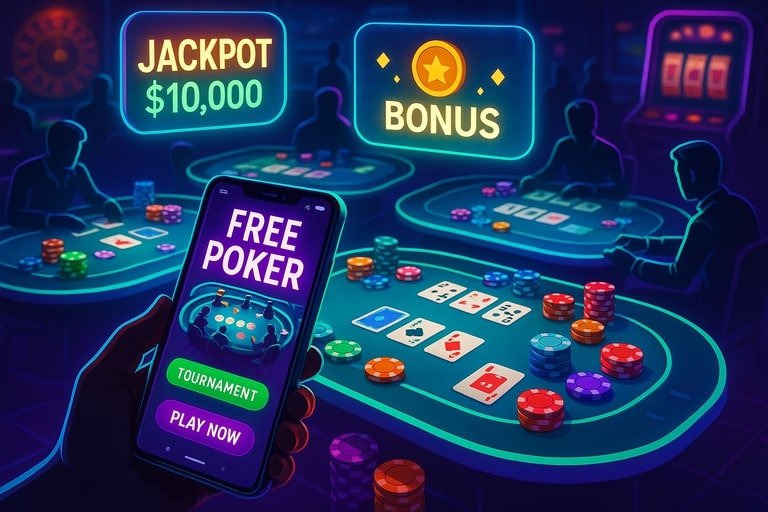
Free poker has become one of the most influential entry points into the casino ecosystem, offering players the chance to develop skills without risking deposits. While no real money is at stake, the dynamics of free poker tables replicate those found in cash games and tournaments, including betting patterns, hand probabilities, and opponent psychology. This makes free poker a valuable training ground, where players can build discipline and decision-making experience before transitioning to real-money environments. However, to gain meaningful insights, participants must treat free sessions as seriously as paid ones.
A defining strength of free poker is its accessibility. Online casinos and poker providers often integrate free tables into their platforms, enabling players to engage without committing deposits. For mobile-first users, these games extend across apps, offering responsive design and stable connectivity. This accessibility ensures a wide range of demographics participate, from beginners learning hand rankings to experienced players refining advanced strategies. Anchors like how to play free poker provide structured entry points for novices who want to grasp fundamentals before moving forward.
Bonuses also intersect with free poker. Some operators provide practice chips or promotional freerolls that blend free play with real-money incentives. These events allow users to compete for small jackpots or bonus credits without upfront costs. While enticing, it is critical to evaluate attached wagering requirements. For example, freeroll winnings may need to be played multiple times before withdrawal becomes possible. Anchors to best casino bonuses explain how to differentiate between promotional value and marketing fluff.
The influence of RTP and rake applies indirectly to free poker. While players do not contribute real funds, understanding how casinos profit through rake in cash games highlights the structural realities awaiting those who transition to paid play. Recognizing that free environments lack rake but mimic betting patterns helps players prepare for real scenarios. Anchors like safe slots online can provide broader lessons on evaluating operator transparency across all casino formats.
Mobile play dominates the free poker market. Providers ensure seamless cross-device compatibility, allowing players to experiment with multi-table strategies, tournaments, and casual games on the go. Stable payment systems matter less in free environments, but secure account creation, reliable logins, and responsible play tools remain crucial.
Live dealers rarely intersect with free poker, as human-hosted environments usually involve real stakes. However, simulated live formats exist, creating atmospheres similar to professional tables. These encourage players to develop etiquette and focus, aligning free experiences with professional standards.
Jackpots are typically absent from free poker, yet freeroll tournaments often substitute this excitement with prize pools funded by providers. While far smaller than progressive jackpots in slots, these pools create motivation and simulate competitive pressure. Anchors to progressive jackpots contextualize the aspirational psychology shared across casino verticals.
Responsible gambling should not be ignored simply because free poker does not involve deposits. Players can still develop unhealthy behaviors such as excessive time commitments or chasing unrealistic expectations. Licensed providers encourage moderation by integrating reminders and responsible play resources, reinforcing sustainable habits before players transition into real-money games.
Deposits and withdrawals become relevant once players move beyond free poker. Understanding verification, withdrawal policies, and payment system reliability prepares users for smooth financial engagement later. Observing these systems during free play ensures players avoid problematic platforms in advance.
Providers shape the free poker environment. Leading casino operators and poker networks offer both casual free tables and competitive freerolls, creating ecosystems that balance entertainment and preparation. Tracking updates ensures awareness of evolving formats and promotional opportunities.
In conclusion, free poker serves as both a training ground and entertainment option. By approaching it with seriousness, evaluating bonuses, respecting responsible play, and preparing for transitions to real-money tables, players gain long-term advantages. Knowledge transforms free poker from casual pastime into an educational platform that supports sustainable skill development.
Online Free Poker Power Moves for Real Success
Online free poker provides players with opportunities to refine skills in environments that simulate real competition without financial risk. Success requires adopting structured power moves that convert casual play into disciplined practice. By focusing on game selection, bonus exploitation, bankroll simulation, and responsible play, participants maximize both enjoyment and preparation.
The first power move involves treating free poker with the same seriousness as real-money sessions. Many players disregard strategy at no-cost tables, adopting reckless betting patterns. While entertaining, this fails to prepare them for true competition. Players aiming to progress should study hand odds, position play, and opponent psychology even in free settings. Anchors to how to play free poker provide essential educational material for new learners.
Bonuses tied to free poker further shape engagement. Freeroll tournaments, for instance, allow players to win real money or credits without buy-ins. However, winnings often include wagering requirements before withdrawal. Understanding these terms prevents disappointment and helps align expectations. Anchors like best casino bonuses contextualize how to evaluate freeroll opportunities properly.
Game variety also matters. Online free poker encompasses cash-game formats, sit-and-go tournaments, and multi-table competitions. Exposure to different structures builds versatility, ensuring readiness for diverse real-money opportunities. Evaluating which structures suit a player’s risk tolerance fosters strategic adaptability.
Simulated bankroll management constitutes another power move. Even though free poker involves virtual chips, players benefit by treating these chips as if they were real funds. Setting limits, experimenting with different stakes, and avoiding reckless all-ins build habits that translate directly into real environments. Anchors to safe slots online reinforce the importance of applying responsible habits across platforms.
Mobile optimization remains vital. Free poker platforms optimized for smartphones allow players to practice on the go. Reliability of apps, ease of navigation, and secure logins ensure smooth participation. Reviewing provider reputation ensures technical stability and security, both critical as players progress toward real-money play.
Live dealer interaction is generally absent, yet some platforms replicate the experience with interactive features. This creates an atmosphere resembling professional casinos, preparing players for social dynamics at competitive tables.
Jackpots appear occasionally in freeroll tournaments, motivating participation. While far smaller than slot-based progressives, these prizes add excitement and simulate competitive pressure. Anchors like progressive jackpots situate this within the broader psychology of aspirational play.
Providers influence success significantly. Trusted casino operators integrate free poker into wider ecosystems, offering smooth transitions to paid games. Evaluating providers based on licensing, responsible play tools, and transparency ensures that practice aligns with safe environments.
Deposits and withdrawals come into play when players advance beyond free stages. Observing how providers manage payment processing prepares users to identify reliable operators. Transparency in terms and conditions should guide long-term trust.
Internal anchors reinforce structured learning. References to how to play free poker, best casino bonuses, and safe slots online enrich navigation and strengthen topical authority across winmax24.com.
Ultimately, power moves for online free poker require treating it as more than casual entertainment. By simulating real conditions, scrutinizing bonuses, applying bankroll discipline, and prioritizing responsible gambling, players maximize preparation and sustainability.
Free Poker Tables and Expert Winning Tactics
Free poker tables present unique environments where players can practice skills, refine strategies, and experiment without financial consequences. Yet, winning tactics in these settings demand more than endless hands; they require discipline, structure, and awareness. By leveraging free tables as learning laboratories, participants build competitive foundations that carry into real stakes.
The first tactic involves practicing position play. Understanding the advantages of late versus early positions transforms decision-making and betting efficiency. Even at free poker tables, disciplined positional play develops long-term habits. Anchors like how to play free poker provide structured guidance for mastering this principle.
Bonus opportunities, including freerolls and promotional practice chips, serve as another tactic. Players who engage consistently in these events maximize their exposure to competitive structures. However, reading bonus terms carefully ensures expectations remain realistic. Anchors to best casino bonuses contextualize promotional evaluation.
Bankroll simulation strengthens tactical preparation. Even though chips are free, experts track results and impose imaginary limits to replicate real-money pressure. This instills discipline, discourages reckless all-ins, and fosters patience. Anchors like safe slots online reinforce responsible gambling principles that span across platforms.
Tournament practice adds value. Free multi-table formats replicate real-world dynamics such as blind escalation, bubble play, and final-table pressure. By experiencing these scenarios, players prepare for eventual entry into paid tournaments with realistic expectations.
Mobile readiness ensures flexibility. Playing on mobile devices allows for consistent practice across varied schedules. Stability and responsiveness matter even in free play, as unreliable apps risk undermining preparation.
Providers shape the quality of free poker tables. Reputable operators maintain fair environments that simulate authentic experiences, whereas low-quality platforms may foster unrealistic habits. Evaluating provider reputation ensures that practice remains relevant.
Jackpot structures occasionally appear in freeroll formats, offering cash or prize pools. These experiences simulate pressure and teach players to manage risk at critical stages. Anchors to progressive jackpots add context for aspirational elements of gameplay.
Responsible gambling tactics should be applied even in free poker. Players risk time investment and potential unhealthy behavior despite the absence of monetary loss. Licensed casinos enforce moderation tools to protect participants, fostering sustainable engagement.
Deposits and withdrawals matter once players transition into real stakes. Evaluating transparency in payment systems prepares users to select reliable operators when moving beyond free play.
Internal anchors enhance flow and authority. References to how to play free poker, safe slots online, and best casino bonuses ensure cohesive learning while supporting SEO.
In conclusion, free poker tables provide fertile ground for skill-building when approached strategically. Through disciplined bankroll simulation, bonus evaluation, and responsible play, players convert free environments into meaningful preparation for long-term poker success.
How to Play Free Poker: A Complete Beginner-to-Expert Guide
Poker has long been one of the most exciting and strategic card games in the world. From the classic saloons of the Wild West to today’s online platforms, the game has evolved into a global phenomenon. But many newcomers aren’t ready to risk real money just yet and instead want to know how to play free poker—a safe and enjoyable way to build skills, learn strategies, and have fun without financial risk.
This guide explains everything about free poker: where to play, rules and variations, strategies for success, and the responsible habits that make the game enjoyable long-term.
Why Learn How to Play Free Poker?
Understanding how to play free poker comes with several unique benefits:
No Risk Learning – Experiment with strategies without losing money.
Skill Development – Practice hand rankings, betting rounds, and bluffing techniques.
Accessibility – Play instantly on websites, apps, or social platforms.
Entertainment – Enjoy poker purely as a recreational game.
Preparation for Real-Money Games – Gain confidence before stepping into higher-stakes environments.
Free poker is more than a casual pastime—it’s a gateway to mastering one of the most strategic card games ever created.
The Basics of Poker
Before you master how to play free poker, you must understand the core rules.
Hand Rankings (Strongest to Weakest):
Royal Flush (A, K, Q, J, 10 of the same suit)
Straight Flush (five consecutive cards, same suit)
Four of a Kind
Full House (three of a kind + a pair)
Flush (five cards, same suit)
Straight (five cards in sequence, mixed suits)
Three of a Kind
Two Pair
One Pair
High Card
Standard Game Flow (Texas Hold’em):
Blinds Posted – Players to the dealer’s left post small and big blinds.
Hole Cards Dealt – Two cards face down to each player.
Betting Rounds – Occur after the flop (3 cards), turn (1 card), and river (1 card).
Showdown – Best five-card hand wins.
Knowing these basics is essential to anyone learning how to play free poker effectively.
Popular Free Poker Platforms
If you want to practice, there are countless places where you can learn how to play free poker online:
Dedicated Apps – Zynga Poker, WSOP Free Play, and PokerStars Play offer massive communities.
Casino Demo Sections – Many online casinos host free poker tables or practice games.
Training Sites – Platforms designed to teach strategy often include free poker rooms.
Social Media Games – Facebook and mobile platforms provide casual free poker tables with friends.
These options let you practice anytime, anywhere, at your own pace.
Strategies for Free Poker Success
While no money is on the line, practicing smart strategies in free games builds habits for when real stakes are involved.
Play Tight, Aggressive – Focus on strong hands, and when you play, bet confidently.
Positional Awareness – Playing later in the betting round gives you an advantage.
Observe Opponents – Even in free games, player tendencies are visible.
Don’t Over-Bluff – Many free players call too often, making excessive bluffing ineffective.
Bankroll Simulation – Treat free chips as though they were real to simulate proper discipline.
Applying these methods while learning how to play free poker ensures long-term improvement.
Benefits of Practicing in Free Poker Rooms
Free poker offers advantages that extend beyond risk-free play:
Learn Betting Structures – Practice fixed-limit, pot-limit, and no-limit formats.
Explore Variations – Texas Hold’em, Omaha, Seven-Card Stud, and more.
Develop Patience – Folding weak hands builds discipline.
Sharpen Math Skills – Pot odds and probability analysis become second nature.
Build Confidence – Gain the self-assurance to transition to real-money tables.
These benefits highlight why so many players start their poker journey with free games.
Free Poker vs. Real-Money Poker
Knowing how to play free poker differs from playing with cash, but both have value.
Free Poker – Great for learning rules, practicing strategy, and experimenting.
Real-Money Poker – Requires sharper discipline, psychological tactics, and stronger bankroll management.
Many players use free poker to develop foundational skills before stepping into real stakes.
Common Mistakes Beginners Make
When learning how to play free poker, avoid these pitfalls:
Playing Every Hand – Discipline is key, even in free games.
Ignoring Position – Betting order dramatically affects strategy.
Bluffing Too Often – Free games encourage loose calls, reducing bluff effectiveness.
Not Tracking Performance – Even without money, track wins/losses for improvement.
Treating Free Poker Too Casually – Build good habits as if it were real.
Correcting these mistakes accelerates your learning curve.
Responsible Poker Habits
Free poker also provides a chance to practice responsible gaming.
Set Time Limits – Avoid playing endlessly without breaks.
Keep Perspective – Remember poker is entertainment.
Avoid Tilt – Stay calm after losses, even with free chips.
Know Your Goals – Play to learn and improve, not just to chase wins.
These habits will carry over when you play higher-stakes games.
The Future of Free Poker
Technology continues to transform poker, including free play:
VR Poker – Virtual reality tables create immersive social experiences.
AI Training Partners – Bots that simulate realistic opponents.
Gamified Learning – Achievements and missions tied to practicing strategy.
Cross-Platform Play – Seamless games across devices.
Staying updated ensures your journey in learning how to play free poker remains exciting.
Final Thoughts
Poker is one of the few casino games where strategy matters as much as luck. Learning how to play free poker allows beginners to develop skills without risk while giving advanced players a way to refine strategies and test new ideas.
From understanding hand rankings and betting structures to practicing discipline and responsible play, free poker is the perfect foundation for success. With preparation, patience, and practice, every player can enjoy the thrill of poker—risk-free, skill-driven, and endlessly entertaining.